Building payment infrastructure Africa's regulators can trust
The coordination layer for cross-border payments between Africa's licensed institutions, with compliance and governance built in from the first line of code.
Picture a bank in Lagos that needs to pay a supplier's bank in Nairobi.
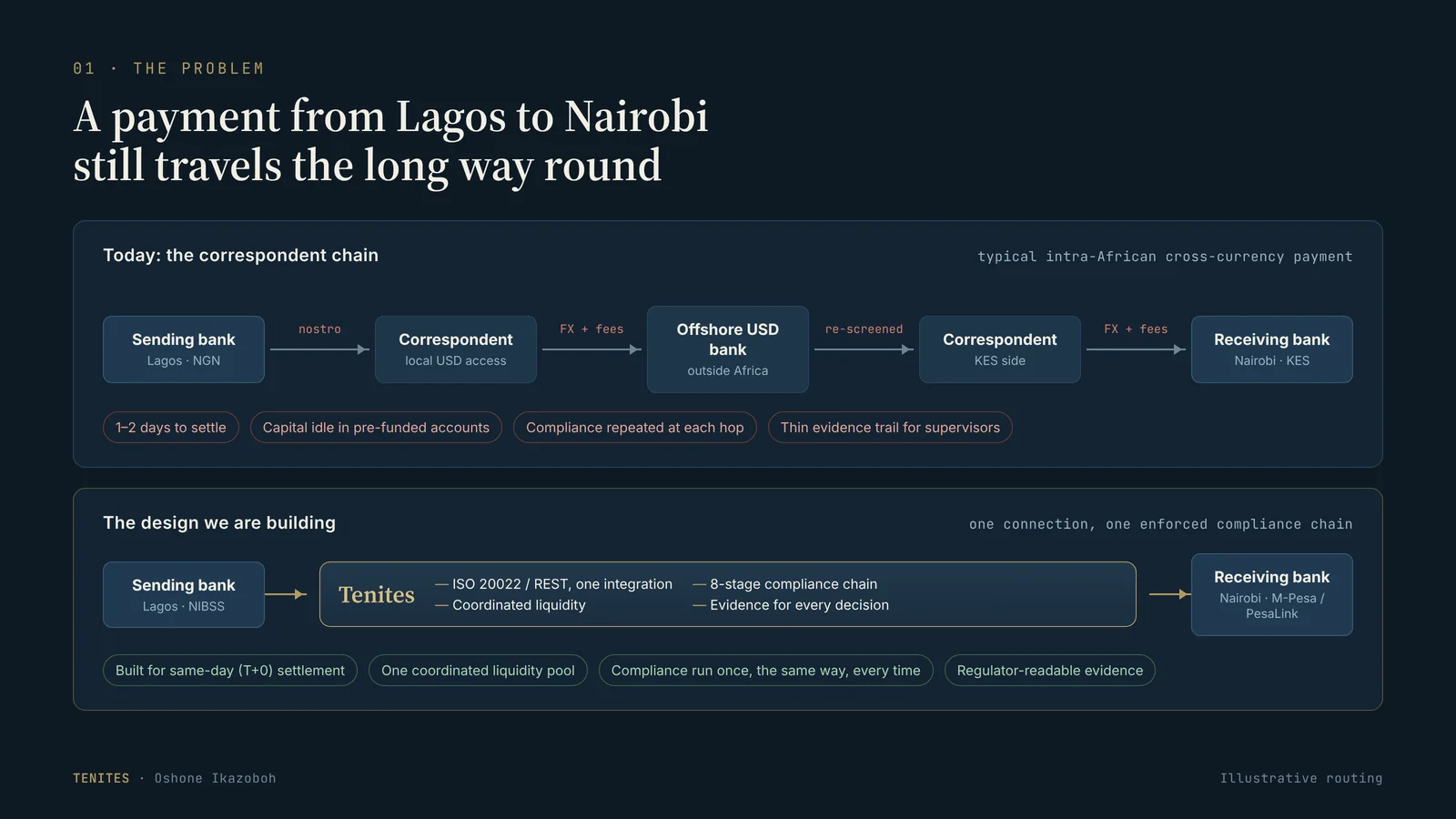
Both cities have excellent domestic payment systems. NIBSS moves naira in seconds. M-Pesa and PesaLink move shillings just as fast. Yet the payment between them usually leaves the continent. It passes through a correspondent, into an offshore US dollar account, through another correspondent, and only then lands in Kenya. That takes one to two days. Every hop needs money parked in a pre-funded account, and every hop screens the payment again. When a supervisor later asks what happened to that payment and why, the answer is spread across four institutions in three jurisdictions.
This isn't one bank's problem. An article in the IMF's Finance & Development magazine (September 2022) reported that, on SWIFT data, only about 12% of intra-African payments were cleared within Africa in 2017, and estimated that routing them through banks overseas adds around US$5 billion a year to their cost.
Africa has built world-class domestic rails. What it has been missing is the layer that connects them with trust. That is what we are building at Tenites.
What changes for a bank
A bank on Tenites maintains one integration instead of a relationship per corridor. It holds less capital idle in pre-funded accounts, because liquidity is coordinated across the network rather than parked at each hop. It cuts the duplicated screening and evidence-gathering that repeats at every hop of today's chain, while each institution keeps its own legal responsibilities. Settlement is designed for the same day. And the bank gets the evidence behind every payment decision automatically, rather than assembling it from other institutions after the fact.
For a treasury team, that means working capital that moves instead of sitting still. For a compliance team, it means one consistent control framework across every corridor. For a supervisor, it means a clear answer to "what happened, and why?"
One connection, across the continent
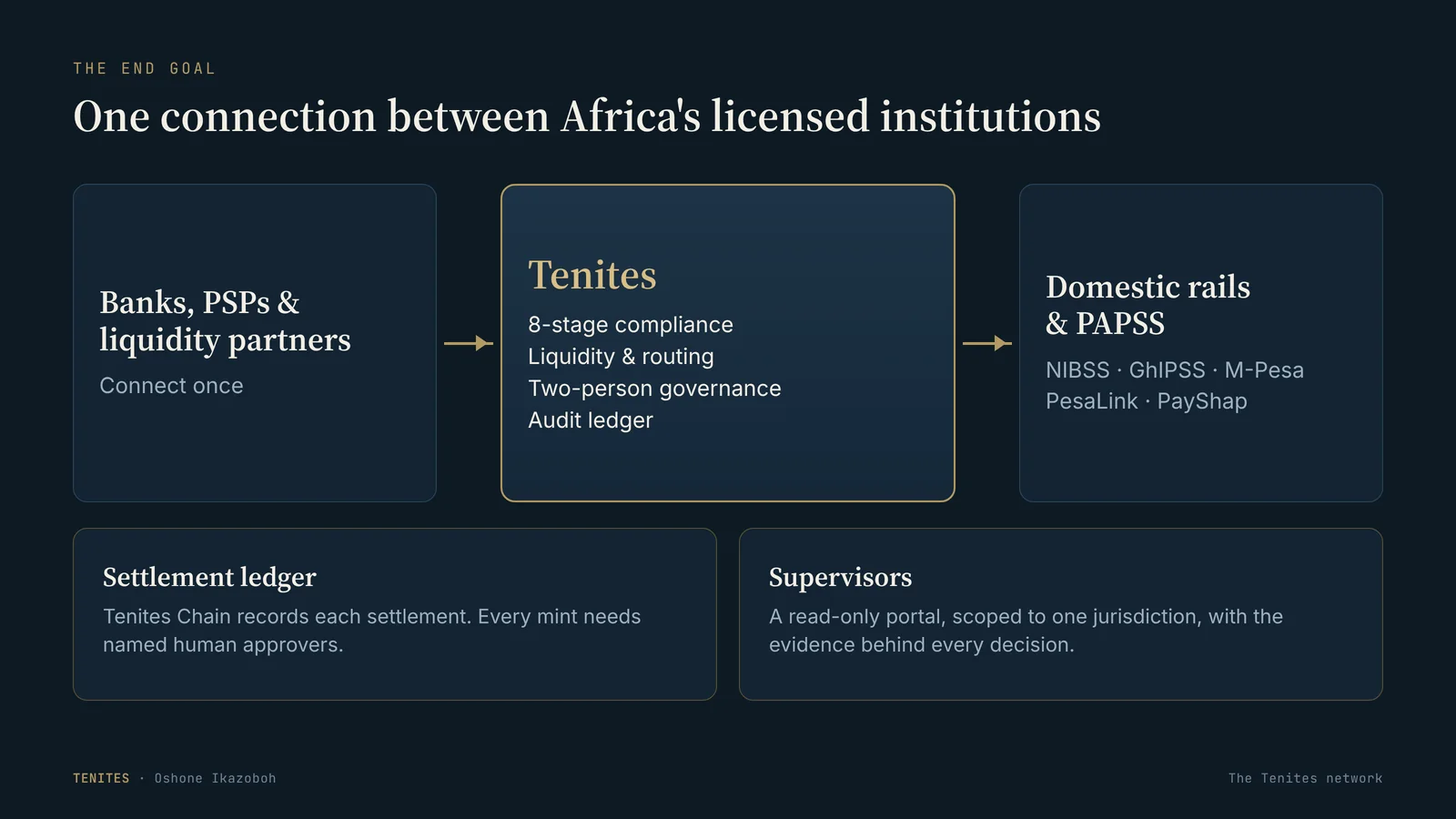
Tenites is a coordination layer for licensed institutions: banks, payment service providers and licensed liquidity partners. They connect once, over ISO 20022 or REST, and reach every corridor on the network.
We are not another payment rail. We are built to work with the rails Africa already has: NIBSS in Nigeria, GhIPSS in Ghana, M-Pesa, PesaLink and RTGS in Kenya, and PayShap in South Africa. PAPSS is infrastructure we are designed to complement, not compete with. What we add is what no single rail provides across borders: compliance, liquidity coordination and evidence.
We are not a consumer product. We don't hold customer funds or serve retail customers. The customer relationship stays with the bank or PSP that owns it, which makes us a partner to fintechs, not a competitor.
Underneath sits a shared, verifiable settlement ledger that no single member controls. Value still settles on the balance sheets of licensed banks and providers. Above it sits a regulator portal that gives each supervisor a read-only view of their own jurisdiction, with the evidence behind every decision.
Compliance is the architecture
Most payment systems treat compliance as a service they call. We built it as the road every payment has to travel.
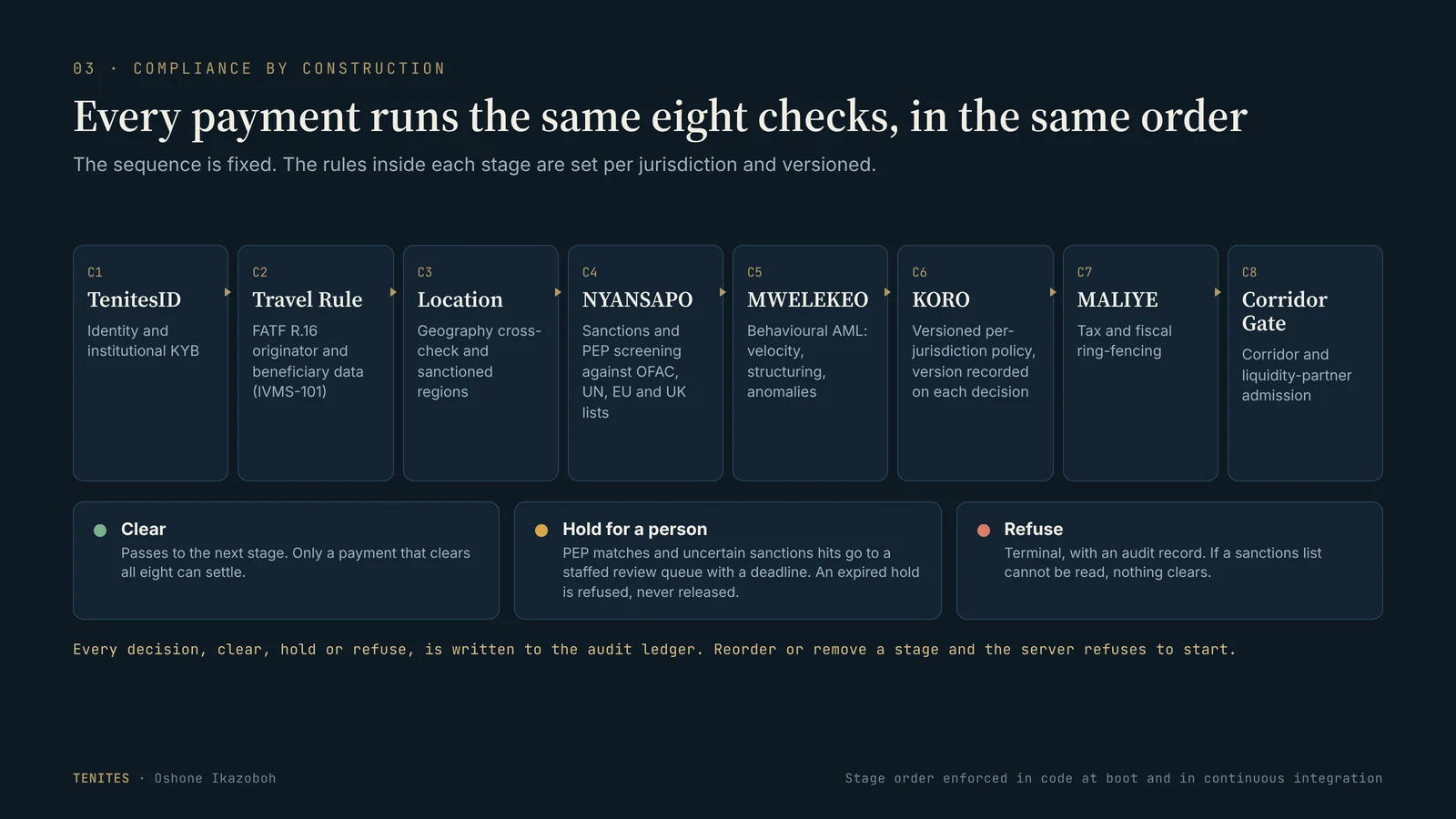
Every payment goes through the same eight checks in the same order. They start with identity and the FATF Travel Rule and run through sanctions screening against the OFAC, UK, EU and UN lists, behavioural AML and per-jurisdiction policy. The rules inside each stage are set for each jurisdiction, and every decision records which version of the rules was applied. The sequence cannot be skipped or reordered: if anyone tries, the platform refuses to start.
When a check is uncertain, a person decides, not a default. A sanctions match that rests on a sound-alike name, or a politically exposed person, goes to a staffed review queue with a deadline. A hold that runs past its deadline is refused, never quietly released. And if a sanctions list can't be read, nothing clears.
Two people, and never an AI
Payment infrastructure fails in predictable ways: one person with too much access, one approval nobody checked, one automated system trusted more than it should be. We designed against all three.
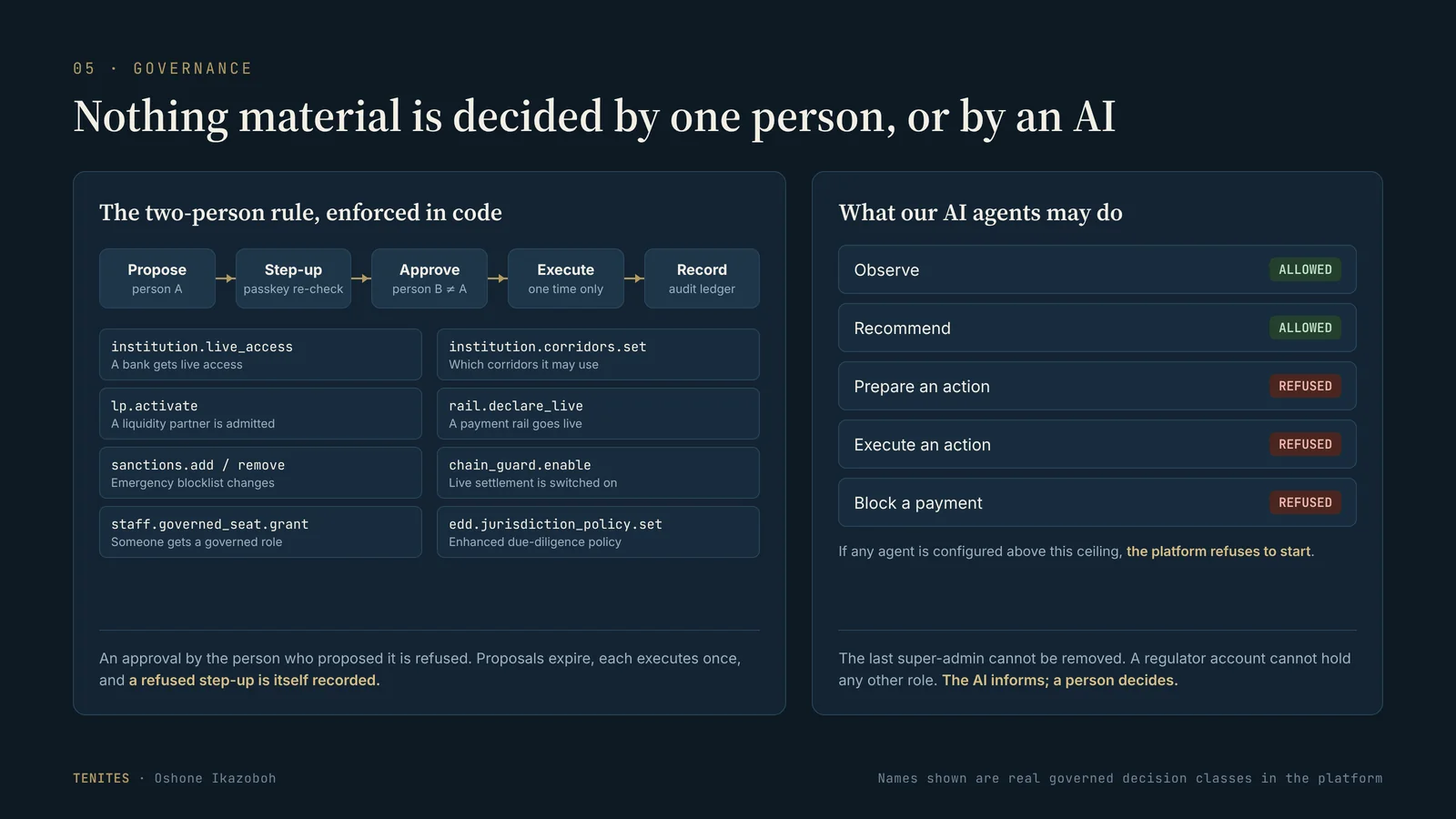
Every material decision on the platform takes two different people, and it executes once and is recorded. That covers giving a bank live access, admitting a liquidity partner, declaring a rail live and switching on settlement.
We use AI agents across our operations to watch, correlate and recommend. But an AI agent at Tenites may not block or move a payment, and the software enforces that. If any agent is configured with more authority, the platform will not start. The AI informs. A person decides.
Every state-changing action on the platform sits inside an automated audit guard that feeds an append-only ledger, which the database itself refuses to edit or delete. We hold ourselves to one rule above the rest: no control is trusted until we have broken the thing it protects and watched it fire.
Where we're going
The core platform architecture is built and running in our production environment ahead of live settlement, and it is open to banks in our sandbox. We have signed partnerships with ARCA, UNISWITCH and Pactis Technology Limited (formerly BVNK Nigeria Ltd), and we are now preparing our first live corridors between Nigeria, Ghana, Kenya and South Africa.
The end state is one trusted network across the continent: a bank in Lagos, Accra, Nairobi or Johannesburg connects once, settles the same day, and can show its supervisor exactly what happened to every payment.
Let's talk
Regulators and supervisors: I would value your perspective early. We will gladly walk you through the regulator portal and the evidence behind a single payment.
Banks and PSPs: if you run corridors across Africa, I'd like to understand where your cost and delay sit today. Our sandbox is open for integration.
Fintechs and liquidity partners: we are building a network, and a network is only as strong as its members.
Investors: we are building infrastructure regulated institutions can depend on. If that is the company you want to back, I'd be glad to talk.
For how we think about settlement between African currencies, read TSC Group's vision paper, Many currencies. One market.
Africa doesn't need another payment app. It needs infrastructure its regulators can trust and its banks can rely on. That is Tenites.
Read the TSC Group vision paper