Make stolen access insufficient to move money
After Black October, the next frontier of financial security is not only making banks harder to hack. It is making sure that breaching an institution is not enough to move the money it controls.
In early October, a wave of cyberattacks hit several Nigerian banks and financial institutions. According to TechCabal's sources, losses could run into billions of naira in customer funds. The attacks affected institutions that rely on outside technology providers for critical services, and in one incident, a vendor providing core banking services was reportedly compromised at the system level on 1 October. A payment gateway executive gave the month its name: Black October. "It eventually ends up at your door," they said.
Much is still unknown: how many attacks there were, how much was lost, and whether the incidents were connected. But the shape of the problem is not new.
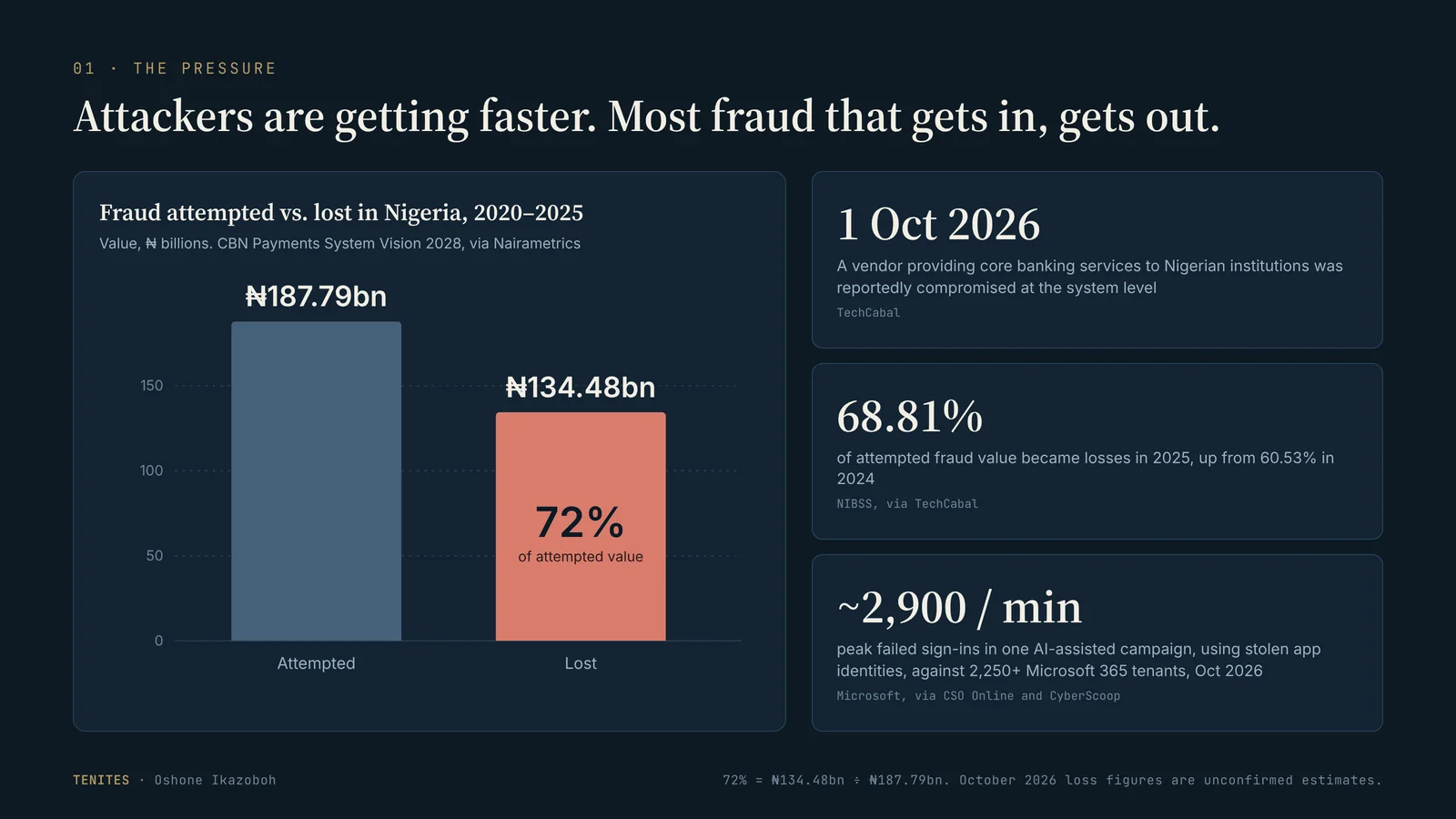
According to the CBN's Payments System Vision 2028, Nigeria recorded ₦187.79 billion in attempted fraud between 2020 and 2025, and ₦134.48 billion was lost. That is roughly 72 kobo of every naira attempted. And the share is rising: NIBSS data cited by TechCabal show 60.53% of attempted fraud became losses in 2024, and 68.81% in 2025. The same CBN report traces much of 2024's losses to a single internal fraud of about ₦30 billion: an attack that started inside the institution, with legitimate access.
The weakness is not missing controls. It is where they live.
It would be unfair to say banks lack authorisation controls. They have transaction limits, segregation of duties, multiple approvals, transaction signing and fraud monitoring.
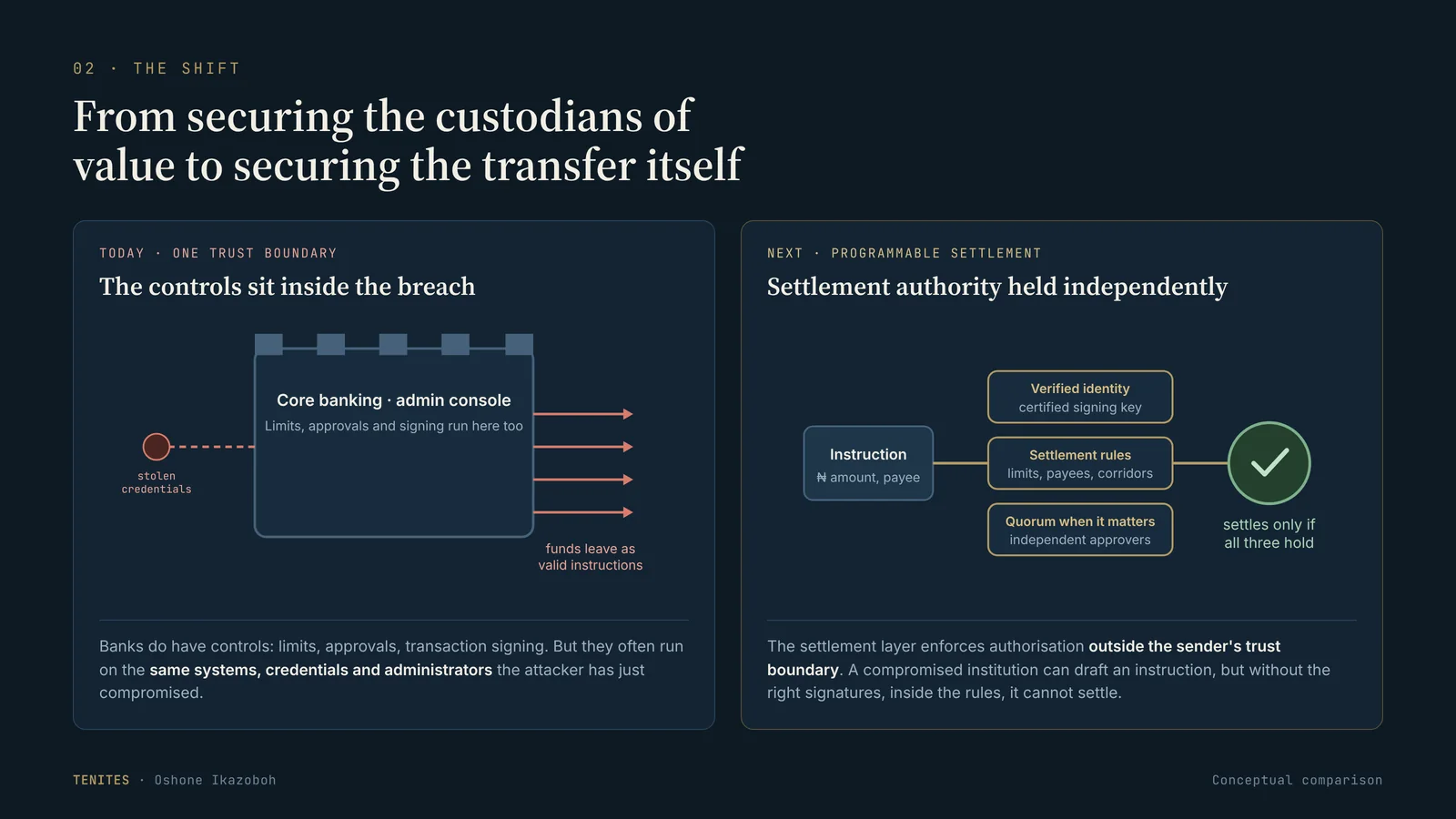
The critical weakness is that those controls often depend on the same systems, credentials or administrators that an attacker has already compromised. The CBN itself names the threats in its Vision 2028: "rising SIM swap incidents, account takeover fraud, insider collusion, and social engineering". Every one of them works by borrowing someone's legitimate access. When an intruder holds a privileged session, or a vendor's platform is breached, the approvals, limits and signing keys sit inside the same trust boundary. They can be bypassed, reconfigured or simply used.
Two trends make this more dangerous.
First, our institutions share infrastructure. As TechCabal put it, "a breach at one provider could expose multiple financial institutions connected to its systems." The CBN's 2024 cybersecurity framework already asks banks to assess the security of their third-party providers, but due diligence on a vendor cannot stop a vendor's compromised system from issuing instructions.
Second, attackers now work at machine speed. In October, Microsoft attributed a campaign against more than 2,250 Microsoft 365 tenants to a state-aligned group using an AI-assisted attack tool and stolen application identities. At its peak, it generated about 2,900 failed sign-in attempts a minute. As Columbia professor Junfeng Yang told Fortune: "Humans don't work at the speed of AI. That is the asymmetry right now."
To be clear, there is no public evidence yet that the Nigerian incidents were AI-driven. But the direction of travel is plain. A defence built mainly on keeping attackers out will lose some of those races. The question is what happens to the money when it does.
Programmable settlement, not just programmable money
These two ideas are often blurred, so it is worth separating them.
Programmable money is value whose permitted uses or transfers are governed by conditions written into the money itself.
Programmable settlement is infrastructure that evaluates and enforces conditions before it transfers or settles value, whatever form that value takes.
The protection I am describing comes from the second. We do not need to reinvent money to get it. We need an independent control layer around the payment and settlement systems we already have.
I believe the next evolution in financial security is programmable settlement with identity-bound authorisation. Value moves only under predefined rules and cryptographically verified permissions, and those rules are enforced outside the trust boundary of the institution sending the payment.
The idea is simple. Even if a bank or custodian is compromised, attackers should not be able to move funds outside authorised conditions on their own. Every transaction is tied to verified identities, certified digital signatures and enforceable settlement rules.
Five checks, and who controls them
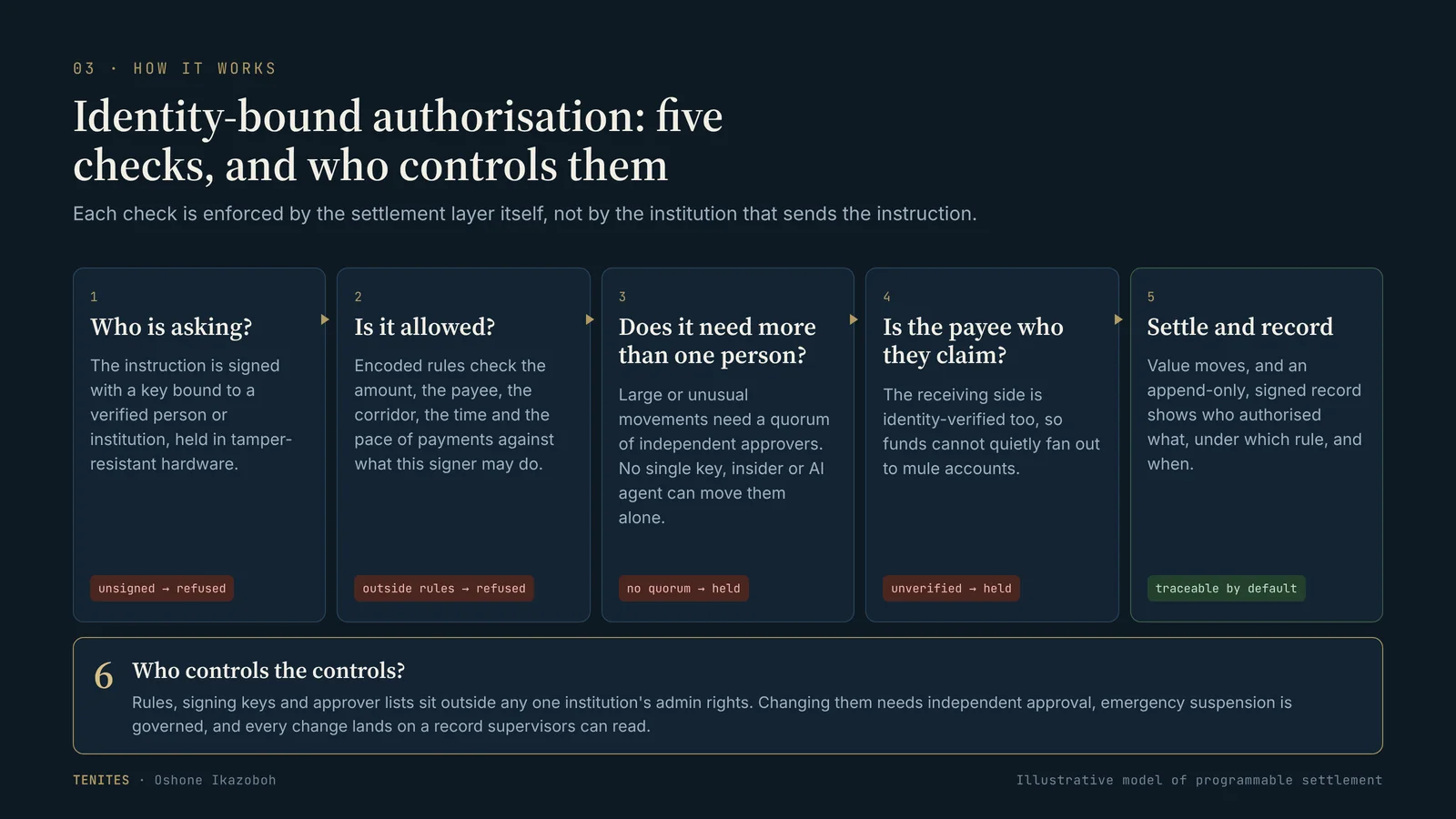
In this model, a payment must clear five checks before it settles, and the settlement layer enforces them, not the institution that sent the instruction:
- Who is asking? The instruction is signed with a key bound to a verified person or institution, held in tamper-resistant hardware, and the signature is bound to the exact amount and payee. A logged-in session is not enough.
- Is it allowed? Encoded rules check the amount, the payee, the corridor, the time of day and the pace of payments against what that signer is permitted to do.
- Does it need more than one person? Large or unusual movements need a quorum of independent approvers. No single key, insider or AI agent can move them alone.
- Is the payee who they claim? The receiving side is identity-verified too, so funds cannot quietly fan out to newly opened mule accounts.
- Can we prove what happened? Value moves, and a signed, append-only record shows who authorised what, under which rule, and when.
None of this works without a sixth principle: who controls the controls? If the same compromised administrator can change the rules, register a new signing key or lift a payee restriction, the protection disappears. So rules, keys and approver lists must sit outside any one institution's administrative rights. Changing them needs independent approval. Emergency suspension and recovery are governed. Every change lands on a tamper-evident record that auditors and supervisors can read.
The same breach, twice
Imagine an attacker obtains administrator access at 02:14.
When the controls sit inside the breached boundary, the attacker can queue hundreds of transfers and approve them from the same compromised console. Funds fan out across dozens of mule accounts and are drained before the fraud is discovered at the start of business. Recovery is partial at best.
When settlement authority is held independently, the same credentials open the same console, but the instructions do not carry signatures from the authorised keys, so the settlement layer refuses them. A signed but unusual batch breaks the pace and payee rules and is held for a human quorum. Alerts fire, and the refused attempts are already on the record. By morning the team is investigating a breach in which no money left.
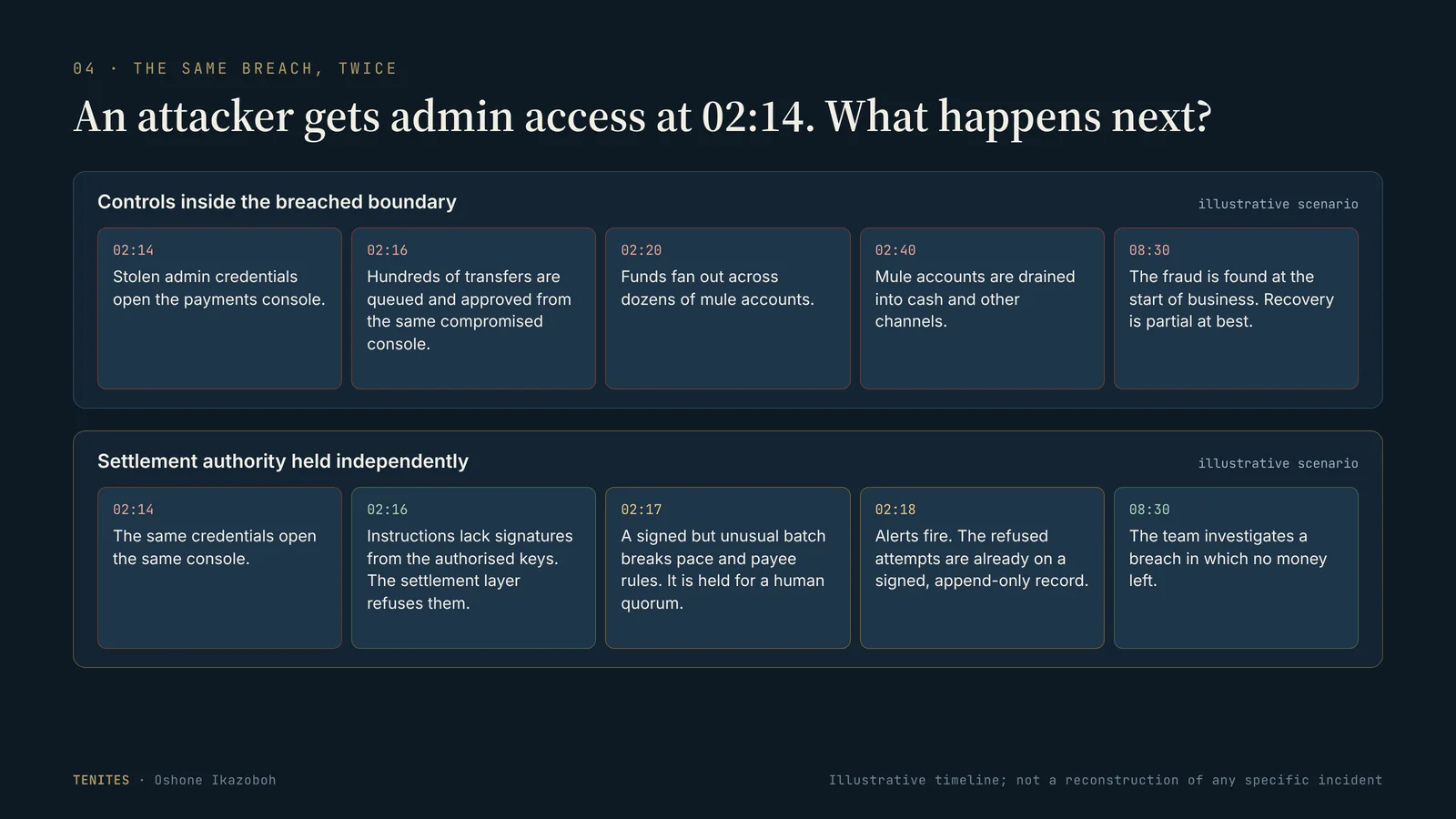
The attacker still got in, and a breach can still expose data or disrupt service. But they could not move the money. That is the shift: stolen access is not settlement authority.
What it will not fix
Programmable settlement is not a silver bullet, and treating it as one would create new risks. Four questions deserve honest answers before anyone builds it at scale:
- Who governs the rules? If rules are code, changing them is a powerful act. Rule changes need the same discipline as the payments they control: more than one person, a recorded reason, and a trail a supervisor can read.
- Where do keys live? If signatures replace sessions, attackers will go after the keys. Keys belong in hardware security modules, spread across independent holders, with no single person able to act alone.
- How fast is too slow? Every hold adds friction. The art is putting friction where risk is, so that ordinary payments stay fast and only the unusual waits for a human.
- How do we recover? Rules that refuse bad payments must not trap good ones. There must be a governed path to unblock legitimate activity quickly, and to reverse errors within the law.
None of these is a reason to wait. They are the design brief.
Trust that does not depend on every participant
The CBN is already moving. Its Vision 2028 proposes a national Security Operations Centre and a fraud intelligence-sharing platform, with an ambition to cut fraud losses by 70% by 2028. In January it directed NIBSS to debit the settlement accounts of banks that receive fraud proceeds. Both make institutions better at seeing fraud and paying for it. Programmable settlement is the complementary step: making fraudulent value harder to move in the first place.
This matters most where several institutions meet. A cross-border payment can pass through a sending bank, a payment provider, a liquidity partner and a receiving bank, in different jurisdictions, each with its own security environment. Today, each one has to trust that the others have not been compromised.
Programmable settlement changes that. Regulated institutions should not need to trust one another's internal security to settle value safely. They need to trust the rules, the signatures and the record, all of which can be verified independently.
The next generation of financial infrastructure must be built on a different assumption: every institution can be compromised, but no single compromise should be enough to move value. That means separating access from authority, identity from credentials, and payment instructions from independently enforceable settlement permissions.
At Tenites, this is the architecture we believe should underpin the next generation of regulated settlement infrastructure, and the principle our settlement layer is designed around: identity-bound authorisation, programmable transaction controls, independent approvals and verifiable records of every movement of value.
For banks, payment providers and regulators, the opportunity is bigger than preventing the next cyberattack. It is a financial network in which trust no longer depends entirely on the security of any single participant.
The future of financial security is not a world where institutions cannot be breached. It is a world where breaching an institution is no longer enough to steal the money it controls.
That is the promise of programmable settlement, and it is the infrastructure we should be building now.
Read: Building payment infrastructure Africa's regulators can trust
Sources
- TechCabal, "A wave of cyberattacks hit Nigerian banks, billions at risk" (13 Nov 2026), for the October incidents, NIBSS loss ratios, the CBN Vision 2028 quote and measures, and the CBN's January directive
- CBN Payments System Vision 2028 fraud figures, as reported by Nairametrics (19 Jun 2026)
- Microsoft's attribution of the ConnectWise campaign to Storm-0940, as reported by CSO Online and CyberScoop
- Fortune, "Cyber expert says companies should face criminal charges amid 'Black October' AI hacks" (29 Oct 2026)